LONG-CUT PASTA PRODUCTION LINE
Design and manufacture of industrial long-cut pasta lines with capacities of 1, 2 and 3.5 tons per hour, running on wheat flour. Fully automatic and turnkey, from flour dosing to packaging.
PRODUCTION PROCESS
Select a step to see where it sits on the line and how it works.
Flour is conveyed from the silo or hopper pneumatically or by screw and dosed precisely into the line, keeping the flour-to-water ratio constant throughout production.
Flour and water are pre-mixed in a high-speed mixer, then homogenized in the kneader. De-aerating the dough under vacuum ensures a clear yellow color and stronger strands.
The screw forces the dough through the die at controlled pressure and temperature, forming strands with a precise cross-section and an even surface.
Strands leaving the die are hung evenly on rods and their ends are trimmed; the trimmings are returned to the press.
Surface moisture is quickly reduced with controlled warm air, so the strands hold their shape and don’t stick together.
A multi-tier tunnel with independent temperature, humidity and airflow control in each zone brings moisture down gradually to the standard level, without cracking.
Core and surface moisture are equalized and the product is cooled to ambient temperature, so it doesn’t crack in storage or packaging.
Strands are removed from the rods and cut to their final length; empty rods return automatically to the start of the line.
Automatic weighing and packaging in film or cartons. This section is optional, depending on your project, and can be added to the line.
LINE OVERVIEW
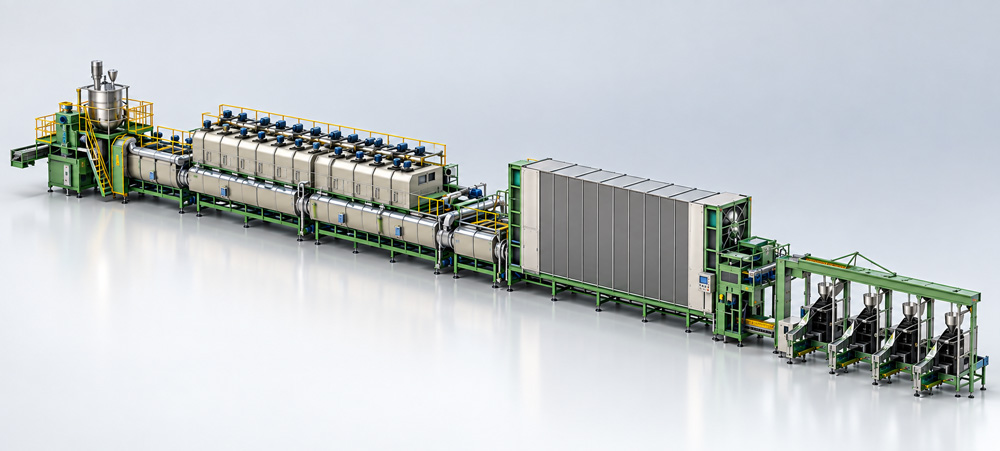
The ATA spaghetti line is designed for continuous, stable production of long-cut pasta. Its modular structure lets you choose a capacity that fits your target market and expand it in the future.
The line runs on wheat flour and needs just one operator. A multi-stage drying tunnel, controlled air circulation and PLC-based automation ensure even drying, a lower risk of cracking and consistent quality of the finished product.
Each drying stage is managed independently, with control of temperature, humidity and airflow, so the product stays consistent across different climates and raw materials.
TECHNICAL SPECIFICATIONS
The line is built in three standard capacities: 1, 2 and 3.5 tons per hour. Select a capacity to compare.
| Specification | 1,000 kg/h | 2,000 kg/h | 3,500 kg/h |
|---|---|---|---|
| Hourly capacity | 1 t | 2 t | 3.5 t |
| Daily output (24 h) | 24 t | 48 t | 84 t |
| Build time | 18–24 months | 18–24 months | 18–24 months |
| Installation & commissioning | 2–3 months | 2–3 months | 2–3 months |
| Line operators | 1 + packaging | 1 + packaging | 1 + packaging |
| Power consumption | Once capacity is selected | Once capacity is selected | Once capacity is selected |
| Line dimensions | Once capacity is selected | Once capacity is selected | Once capacity is selected |
* Daily output is based on rated capacity and continuous 24-hour operation. Dimensions, power consumption and other technical data are provided once a capacity is selected.
Wheat flour
Fully automatic PLC control with HMI touch panel
1 operator for the whole line + 1 per packaging machine
Continuous 24-hour industrial production
Stainless steel on all food-contact parts
Hot water or thermal oil (depending on site utilities)
Lifetime, with periodic servicing and proper maintenance
Lifetime: spare parts, troubleshooting and technical support
WHY THIS LINE
Independent temperature, humidity and airflow control in each zone for even, crack-free drying of the strands.
Removing air bubbles from the dough gives a clear yellow color, a smooth surface and a firmer finished product.
Increase capacity or add a packaging section later, without major changes to the line.
Fully insulated tunnels and return-air management cut energy consumption and production costs.
Run the whole line from one panel, store production recipes and get fault alarms — minimal labor cost.
Built in-house, with fast spare-parts supply, troubleshooting and after-sales service for the life of the machine.
FAQ
Answers to the most common questions about the spaghetti production line. Have another question? Talk to our engineers directly.
The line is built in three standard capacities: 1, 2 and 3.5 tons per hour — roughly 24, 48 or 84 tons of product per 24-hour day. See the technical specifications table to compare.
The line runs on wheat flour. Water dosing, press settings and the drying recipe are tuned to the properties of your flour.
Building the line takes 18 to 24 months, and installation and commissioning at your plant take 2 to 3 months. A detailed schedule is provided with the technical proposal.
One operator controls the entire line. For packaging, allow one operator per packaging machine.
The line is designed and built for a lifetime of service, and after-sales service, spare parts and technical support are likewise provided for life.
Yes. The equipment and control system are designed for continuous three-shift industrial production, with only planned stops for cleaning and maintenance.
Line dimensions, power consumption and other technical data depend on the chosen capacity and are provided once a capacity is selected, together with a layout drawing and a list of utility requirements.
Tell us your target capacity, hall dimensions and utilities, the number and type of packaging machines, and the installation location, and we will prepare a technical and commercial proposal.