SHORT-CUT PASTA PRODUCTION LINE
Design and manufacture of industrial short-cut pasta lines — penne, elbows, fusilli and shells — with capacities of 1 and 2 tons per hour, running on standard wheat flour. Fully automatic and turnkey, from flour intake to storage silos and packaging.
PRODUCTION PROCESS
Select a step to see where it sits on the line and how it works.
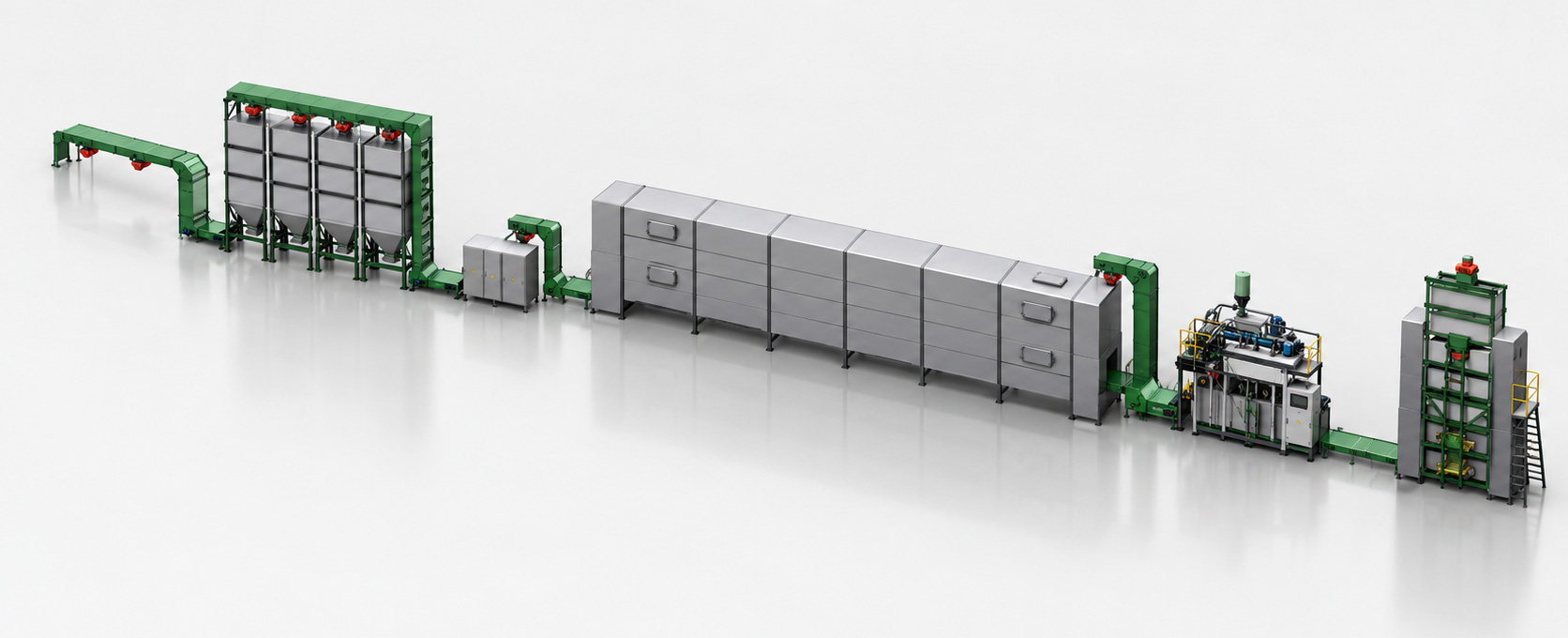
Flour bags are lifted to the top of the tower at the bag-dump station and emptied; after sifting, flour flows continuously to the hopper above the press, so the line never runs short of material.
Flour and water are dosed in an exact ratio and turned into uniform dough in the mixer. The dough is de-aerated under vacuum before entering the screw, then forced through the die at controlled pressure and temperature.
A rotary cutter synchronized with the die output cuts the product to a uniform length. The pre-dryer quickly removes surface moisture so the pieces keep their shape and don’t stick together.
The pre-dried product is carried by elevator to the inlet of the multi-tier dryer — gently and without spillage, keeping breakage and waste to a minimum.
The product travels on multi-tier belts through successive zones. Temperature, humidity and airflow are controlled independently in each zone, so moisture drops gradually to the standard level without cracking.
The dried product is cooled to near ambient temperature and its core and surface moisture are equalized, so it doesn’t crack or sweat in the silos or packaging.
A conveyor above the silos distributes the product between them. The silos act as a buffer between production and packaging: the line keeps running non-stop and each shape is stored separately.
The product is discharged from the silos and carried by a distribution conveyor to the packaging machines. The number of packaging machines is set by your capacity and pack type.
LINE OVERVIEW
The ATA short-cut pasta line is a complete, integrated chain: from the flour intake station and vacuum press to the multi-tier dryer, cooler, storage silos and packaging conveyor. Every stage is run from one PLC control panel, and the entire line needs just one operator.
The line is designed to run on standard wheat flour — a raw material that is easier to source and more economical than semolina. Dosing, press settings and the drying recipe are tuned to the properties of your flour, so the finished product has consistent color, firmness and cooking quality.
By changing the die, a wide range of short-cut pasta — from penne and elbows to fusilli, shells and custom shapes for your brand — is produced on the same line, and the storage silos keep each shape separate.
TECHNICAL SPECIFICATIONS
The line is built in two standard capacities: 1 and 2 tons per hour. Select a capacity to compare.
| Specification | 1,000 kg/h | 2,000 kg/h |
|---|---|---|
| Hourly capacity | 1 t | 2 t |
| Daily output (24 h) | 24 t | 48 t |
| Build time | 9–12 months | 9–12 months |
| Installation & commissioning | 2–3 months | 2–3 months |
| Line operators | 1 + packaging | 1 + packaging |
| Installed electrical power | In the technical proposal | In the technical proposal |
| Dimensions & hall space | In the technical proposal | In the technical proposal |
* Daily output is based on rated capacity and continuous 24-hour operation. Electrical power and exact line dimensions are given in the technical proposal after reviewing your hall layout and project needs.
Penne, elbows, fusilli, shells, rigatoni, soup pasta and custom shapes
Standard wheat flour
Fully automatic PLC control with HMI touch panel
1 operator for the whole line + 1 per packaging machine
Continuous 24-hour industrial production
Stainless steel on all food-contact parts
Lifetime, with periodic servicing and proper maintenance
Lifetime: spare parts, troubleshooting and technical support
PRODUCT RANGE
By changing the die, short-cut pasta in different shapes and sizes is produced on the same line — and we can make a die for your brand’s signature shape.
Penne Rigate
L 40 – 50 mm
Elbow Macaroni
Ø 7 – 9 mm
Spirals
L 35 – 40 mm
Conchiglie
≈ 25 – 30 mm
Ridged tubes
Ø 12 – 15 mm
Ditalini
Ø 5 – 7 mm
WHY THIS LINE
No semolina required — an easy-to-source, economical raw material, with press and dryer settings tuned to your flour.
Removing air bubbles from the dough gives a smooth surface, even color and a firmer finished product.
Independent temperature, humidity and airflow control in each zone, with a separate drying recipe per shape — no cracking.
Decouples production from packaging: the line keeps running non-stop and each shape is stored separately.
Run the whole line from one panel, store a recipe per product and get fault alarms — minimal labor cost.
Built in-house, with fast spare-parts supply, troubleshooting and after-sales service for the life of the machine.
FAQ
Answers to the most common questions about the short-cut pasta line. Have another question? Talk to our engineers directly.
The line is built in two standard capacities: 1 ton (1,000 kg) and 2 tons (2,000 kg) per hour — roughly 24 or 48 tons of product per 24-hour day. See the technical specifications table to compare.
By changing the die, the same line produces short-cut pasta such as penne, elbows, fusilli, shells, rigatoni and soup pasta, as well as custom shapes for your brand. For long-cut pasta, see our spaghetti production line.
The line runs on standard wheat flour; durum wheat semolina is not required. Water dosing, press settings and the drying recipe are tuned to the properties of your flour.
Building the line takes 9 to 12 months, and installation and commissioning at your plant take 2 to 3 months. A detailed schedule is provided with the technical proposal.
One operator controls the entire line, from flour feeding to the storage silos. For packaging, allow one operator per packaging machine.
The line is designed and built for a lifetime of service, and after-sales service, spare parts and technical support are likewise provided for life.
The silos act as a buffer between the dryer and packaging: the line runs non-stop while packaging follows its own schedule and speed.
Hall dimensions, electrical power, water and compressed air depend on the chosen capacity. Once you select a capacity, we provide a layout drawing and a detailed list of utility requirements.
Tell us your target capacity, product shapes, hall dimensions and utilities, the number and type of packaging machines, and the installation location, and we will prepare a technical and commercial proposal.